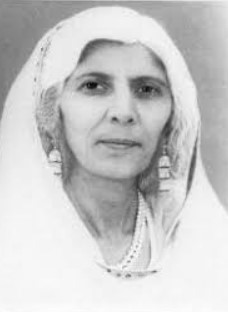
Bi Amma (Abadi Bano Begum)
Bi Amma (1850–1924) — Abadi Bano Begum — was the mother of a revolution. Widowed young and left to raise six children alone in Rampur, she defied every convention of her time to become one of the first Muslim women to address mass political gatherings in British India. She poured her fierce love of country into her sons, Maulana Muhammad Ali Jauhar and Maulana Shaukat Ali, raising them not just as scholars but as warriors for freedom.
When her sons were imprisoned following the 1921 Karachi Trial for sedition, Bi Amma did not retreat into grief — she stepped onto the political stage herself. Breaking the seclusion of purdah, she toured cities across India, standing before crowds of thousands and calling upon women to donate their jewelry, their savings, and their sons to the Tilak Swaraj Fund. Her voice, simple and direct, carried the moral authority of a mother who had already given everything to the cause. She urged the women of India to become soldiers of freedom.
At the 1921 All-India Muslim League and Congress sessions, Bi Amma's presence on the platform was a revolution in itself — a Muslim woman, unveiled, addressing the nation's political leadership. She died in November 1924, but she had already achieved the extraordinary: she had shown that a mother's love, when fused with love of country, could shake an empire.
Sources & Further Reading
Reference Works & Official Portals
- Wikipedia. "Abadi Bano Begum."
- Abadi Bano Begum. Selected speeches in The Comrade and Young India (1919–1924).
Scholarly Books & Women's Histories
- Gail Minault. The Khilafat Movement: Religious Symbolism and Political Mobilization in India. Columbia University Press, 1982.
- Geraldine Forbes. Women in Modern India. Cambridge University Press, 1996.