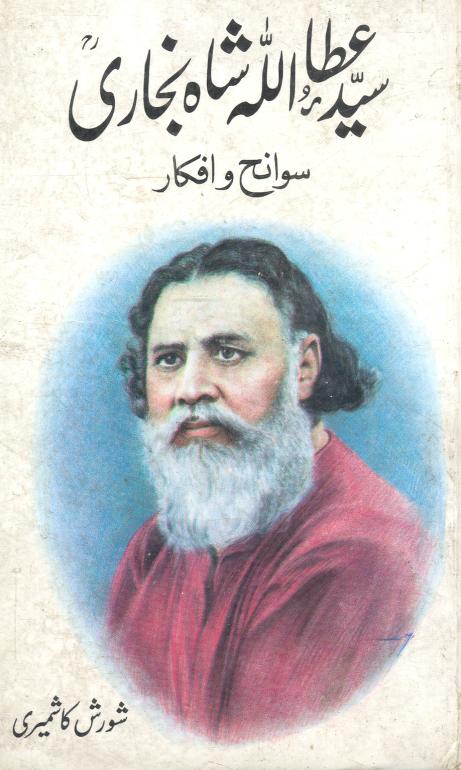
Syed Ataullah Shah Bukhari
Syed Ataullah Shah Bukhari (1892–1961) was the orator who could command crowds of hundreds of thousands with nothing but his voice and his faith. Born in Patna and educated at Deoband, he was gifted with a voice that could hold audiences spellbound for hours — reducing them to tears, stirring them to action, making them believe that freedom was not merely possible but inevitable. He was not just a speaker; he was a force of nature.
In 1929, Bukhari co-founded the Majlis-e-Ahrar-e-Islam in Lahore — a movement that mobilized working-class Muslims, artisans, and peasants against both British colonialism and feudal landlordism. A fierce ally of the Indian National Congress during the Civil Disobedience Movement, he spent over sixteen years in British prisons. The colonial authorities tried everything to break him: solitary confinement, harsh conditions, relentless surveillance. Nothing worked. Every time the jail doors opened, he walked out and resumed speaking.
Bukhari stood resolutely against partition, rejecting the Two-Nation Theory and campaigning across Punjab and the NWFP for a united, secular India. When 1947 came and the subcontinent was carved in two, he remained in Pakistan, continuing his religious and political teaching as an independent voice. He died in 1961 — an empire's most feared opponent, armed with nothing but words.
Sources & Further Reading
Reference Works
Scholarly Books & Monographs
- Samina Awan. Political Islam in Colonial Punjab: Majlis-i-Ahrar 1929–1949. Oxford University Press, 2010.
- Wilfred Cantwell Smith. Modern Islam in India: A Social Analysis. Victor Gollancz, London, 1946.