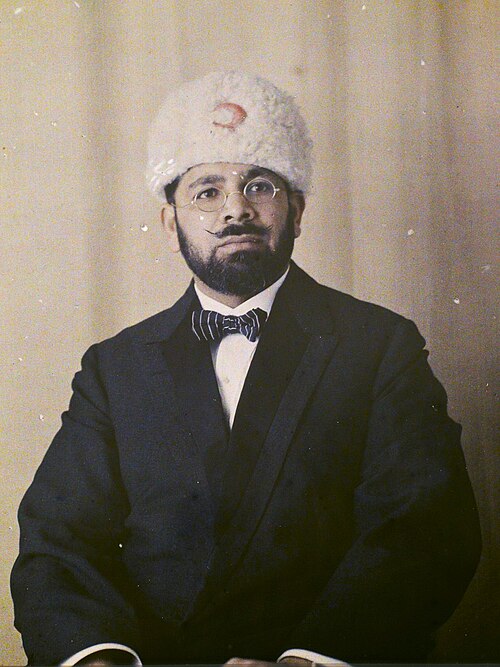
Maulana Muhammad Ali Jauhar
Maulana Muhammad Ali Jauhar (1878–1931) was a firebrand of India's freedom struggle — a journalist whose pen was sharper than any sword, an orator whose voice could move millions, and a leader who literally gave his life for the cause. Educated at Aligarh and Oxford, he returned to India and launched The Comrade (1911) and Hamdard (1913), transforming journalism into a weapon of political awakening that the British Empire could not ignore.
Alongside his brother Shaukat Ali, Muhammad Ali led the Khilafat Movement (1919–1924) and forged one of the most consequential alliances in Indian history — bringing Muslim religious scholars and Mahatma Gandhi's Congress together in an unprecedented united front against colonial rule. A co-founder of Jamia Millia Islamia and President of the Indian National Congress in 1923, he was imprisoned repeatedly, each incarceration only deepening his resolve. His rallies drew crowds in the hundreds of thousands, his words igniting a fire that colonial authorities could neither contain nor extinguish.
In 1930, gravely ill and against his doctor's orders, Muhammad Ali traveled to London for the First Round Table Conference. Standing before the assembled representatives of the British Empire, he declared that he would not return to an enslaved India — that he would rather die a free man in a foreign country than live as a slave in his own. On 4 January 1931, he died in London, and in accordance with his wish, he was buried not in his homeland but in Jerusalem, within the sacred grounds of Al-Aqsa. His epitaph, which he wrote himself, reads simply: "Here lies Muhammad Ali, who chose to die in a foreign land fighting for the freedom of his own."
Sources & Further Reading
Reference Works & Official Portals
Scholarly Books & Biographies
- Mushirul Hasan. Mohamed Ali: Ideology and Politics. Manohar Publications, 1981.
- Gail Minault. The Khilafat Movement: Religious Symbolism and Political Mobilization in India. Columbia University Press, 1982.
- Afzal Iqbal. Life and Times of Mohamed Ali. Institute of Islamic Culture, 1974.
Primary Speeches & Writings
- Afzal Iqbal (ed.). Select Writings and Speeches of Maulana Mohamed Ali. Shaikh Muhammad Ashraf, 1944.