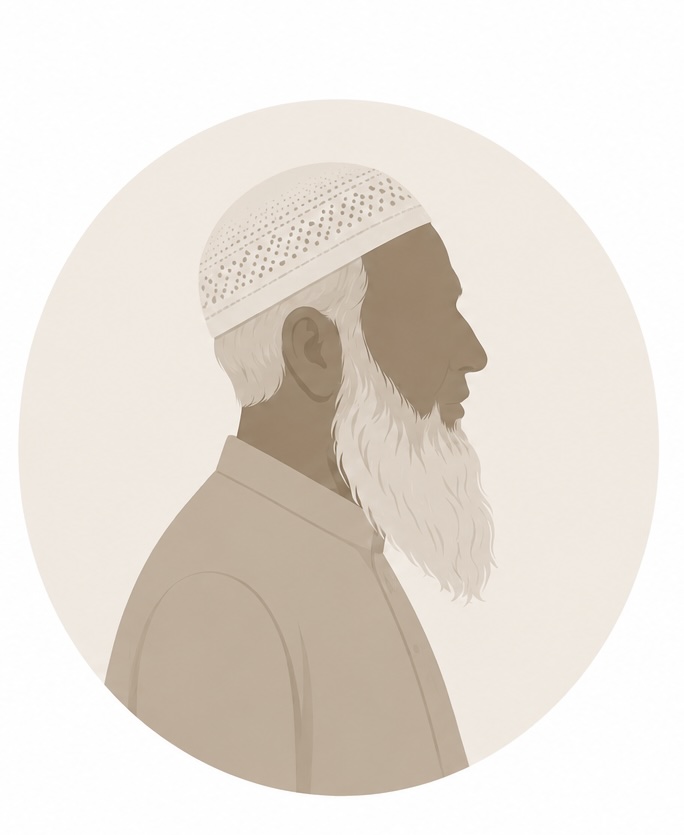
Shah Abdul Aziz Dehlavi
Shah Abdul Aziz Dehlavi (1746–1824) was the scholar who provided the theological foundation for armed resistance against British rule in India. The son of Shah Waliullah Dehlawi, he inherited his father's intellectual mantle but lived through a very different era — one in which the British East India Company was rapidly expanding its territorial control. While his father had died before British dominance, Shah Abdul Aziz witnessed the company's ascendance and issued the most consequential fatwa of 18th-century India: declaring the subcontinent to be Dar-ul-Harb (a land under foreign occupation).
This fatwa had profound implications. It meant that it was no longer permissible for Muslims to live under colonial rule without resisting, that Friday congregational prayers were no longer valid under alien sovereignty, and that armed struggle against the British was a religious obligation. The fatwa directly inspired the Tariqah-i-Muhammadiya movement led by Syed Ahmad Barelvi and Shah Ismail Dehlvi, and it resonated through every subsequent anti-colonial movement led by Muslim scholars — from the 1857 Rebellion to the Silk Letter conspiracy. Shah Abdul Aziz also trained a generation of students who would go on to lead resistance in their own regions.
Beyond the fatwa, Shah Abdul Aziz was a prolific scholar who completed his father's work on Quranic exegesis and Hadith studies, authored Fatawa-e-Azizi, a collection of his legal opinions, and maintained the intellectual tradition of the Waliullahi school. He died in Delhi in 1824, but his legacy as the scholar who declared India a land of war against the British ensured that his name would be invoked by every generation of anti-colonial fighters that followed.
Sources & Further Reading
Reference Works & Encyclopedias
Scholarly Books & Monographs
- S.A.A. Rizvi. Shah Abd al-Aziz: Puritanism, Sectarianism and Jihad. Ma'rifat Publishing House, 1982.
- Barbara D. Metcalf. Islamic Revival in British India: Deoband, 1860–1900. Princeton University Press, 1982.