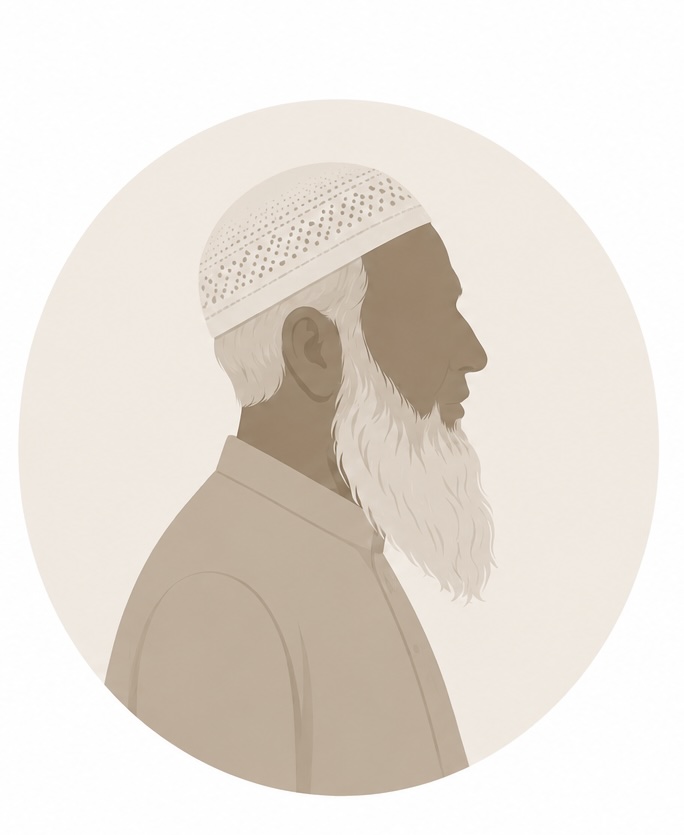
Mufti Kifayatullah Dehlavi
Mufti Kifayatullah Dehlavi (1875–1952) was the Grand Mufti of India who deployed the full weight of Islamic jurisprudence against British rule — a jurist who turned the law, both divine and human, into a weapon of liberation. His nine-volume compendium of legal opinions, Kifayat al-Mufti, addressed thousands of questions, from personal piety to political resistance, and established him as one of the most consulted religious authorities in British India. But Kifayatullah was no quiet scholar content to issue opinions from behind a desk.
As the founding President of the Jamiat Ulema-e-Hind from 1919 to 1940, he aligned the organization of Indian Islamic scholars firmly with the Congress, issuing fatwas that declared participation in non-violent anti-colonial campaigns religiously permissible — indeed obligatory. Under his leadership, the Jamiat became one of the most powerful Muslim voices against partition, arguing from scripture that Muslims and Hindus were one nation bound by common territory and shared destiny. The British imprisoned him repeatedly for these opinions, but they could not imprison the influence of his rulings, which spread through mosques and madrasas across the subcontinent.
Kifayatullah was arrested during the 1930 Salt Satyagraha and again during the Quit India Movement of 1942. Each time he emerged from prison, he resumed his work — teaching, writing, issuing fatwas, and reassuring Indian Muslims that their future lay in a united, secular India. He lived to see independence and died in Delhi in December 1952, having spent his life proving that the law — divine and human — could be a weapon of liberation as powerful as any army.
Sources & Further Reading
Reference Works
Primary Works & Legal Compendiums
- Mufti Kifayatullah Dehlavi. Kifayat al-Mufti (9 Volumes). Maktaba Haqqaniya, Delhi.
Scholarly Books & Studies
- Yohanan Friedmann. "The Attitude of the Jam'iyyat-i 'Ulama'-i Hind to the Pakistan Movement." Asian and African Studies, 1971.
- Barbara D. Metcalf. Islamic Revival in British India: Deoband, 1860–1900. Princeton University Press, 1982.