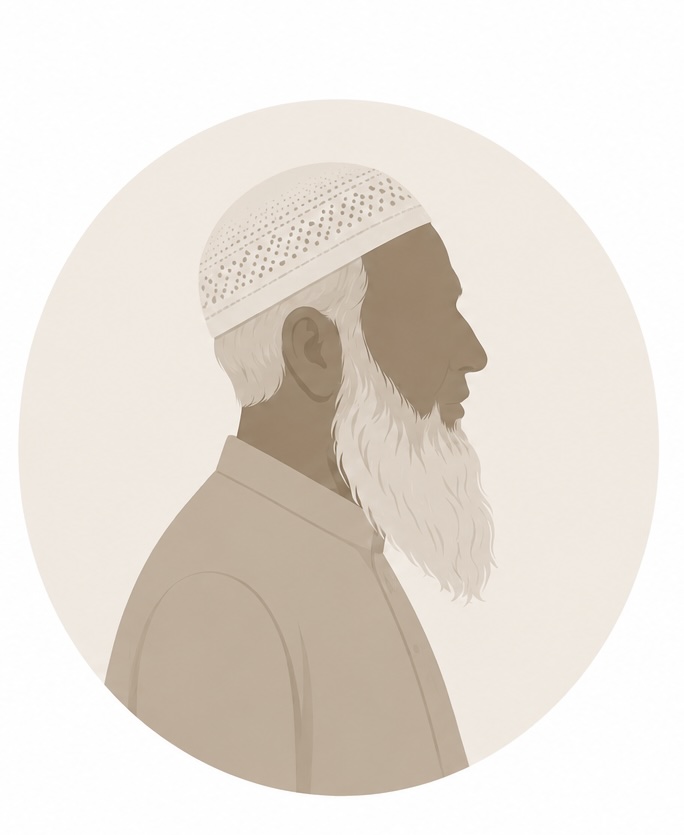
Shah Ismail Dehlvi
Shah Ismail Dehlvi (1779–1831) was the sword arm of the Tariqah-i-Muhammadiya movement — a scholar-revolutionary who combined religious erudition with martial courage and fell fighting alongside Syed Ahmad Barelvi at the Battle of Balakot. Born into the illustrious family of Shah Waliullah Dehlawi, he was the grandson of the great scholar and a nephew of Shah Abdul Aziz, from whom he inherited the mantle of militant resistance against foreign rule.
Shah Ismail was both a theologian and a warrior. His book Taqwiyat al-Iman (Strengthening of the Faith) became one of the most widely circulated texts in 19th-century India, calling on Muslims to purify their faith and reject all forms of oppression and subjugation. But his words were matched by action. In 1826, he joined Syed Ahmad Barelvi's movement and together they built an organized force of thousands of followers committed to liberating the subcontinent from foreign domination. He was the strategist, the organizer, and one of the most fearless commanders on the battlefield.
In May 1831, the British-allied Sikh armies under Maharaja Ranjit Singh cornered Syed Ahmad and Shah Ismail's forces at Balakot in the mountains of the North-West Frontier. On 6 May 1831, Shah Ismail died fighting alongside Syed Ahmad, falling sword in hand. His martyrdom at Balakot, at age fifty-two, sealed his place in the pantheon of India's early anti-colonial martyrs. His writings and his sacrifice continued to inspire resistance movements across northern India for decades after his death.
Sources & Further Reading
Reference Works & Encyclopedias
Scholarly Books & Monographs
- Qeyamuddin Ahmad. The Wahabi Movement in India. Firma KLM, 1994 (2nd Edition).
- Ayesha Jalal. Partisans of Allah: Jihad in South Asia. Harvard University Press, 2008.