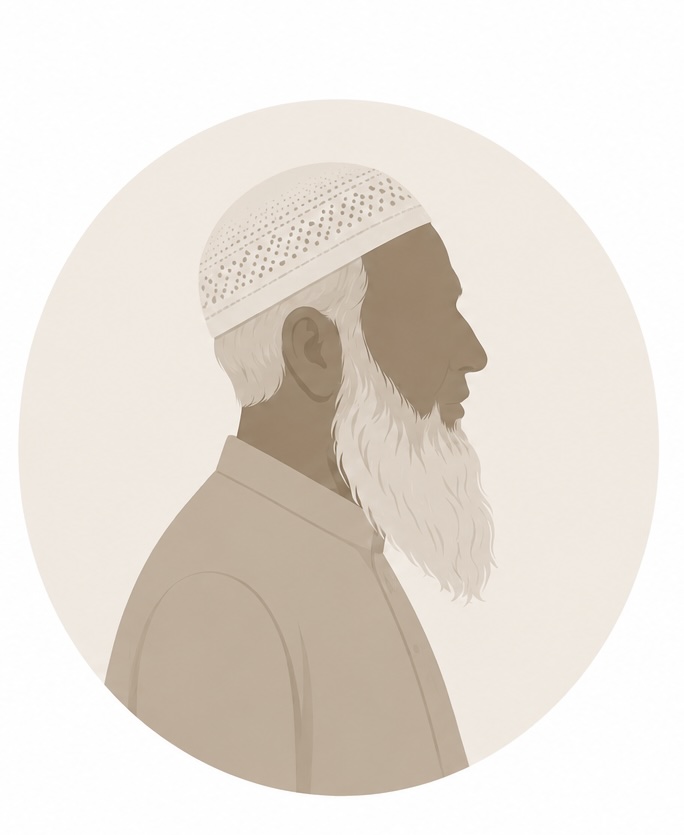
Maulana Shibli Nomani
Allama Shibli Nomani (1857–1914) was born in the year of the Great Rebellion, and like that uprising, his life was a revolt against the status quo — not with swords, but with scholarship. Teaching at Aligarh alongside Sir Syed Ahmad Khan, he soon charted his own course, seeking a middle path between rigid traditionalism and uncritical westernization. He believed that Indian Muslims could honor their heritage while embracing modern research methods, and he spent his life proving it.
In 1898, Shibli founded the Darul Uloom Nadwatul Ulama in Lucknow — an institution designed to produce scholars who were grounded in Islamic tradition yet fluent in modern knowledge. In 1914, he established the Darul Musannefin Shibli Academy in Azamgarh, a pioneer research institution for Urdu literature and Islamic history that continues to produce scholarship to this day. His biographies — Al-Farooq on Caliph Umar, Al-Ghazali on the great theologian, and Shi'r al-Ajam on Persian poetry — set new standards for historical writing in Urdu.
Shibli was not a street agitator or a political organizer. His contribution to the freedom struggle was more subtle and, in some ways, more lasting: he gave Indian Muslims the intellectual tools to understand their own history, to take pride in their civilization, and to resist the cultural domination that was colonialism's most insidious weapon. His writings influenced an entire generation of nationalist leaders, including Maulana Abul Kalam Azad. He died in 1914, but his books — and his institutions — are still teaching.
Sources & Further Reading
Scholarly Biographies & Historiography
- Mehr Afroz Murad. Intellectual Modernism of Shibli Nu'mani. Islamic Research Institute, Islamabad, 1976.
- Shibli Nomani. Al-Farooq: Life of Omar the Great. Darul Musannefin Shibli Academy, Azamgarh.