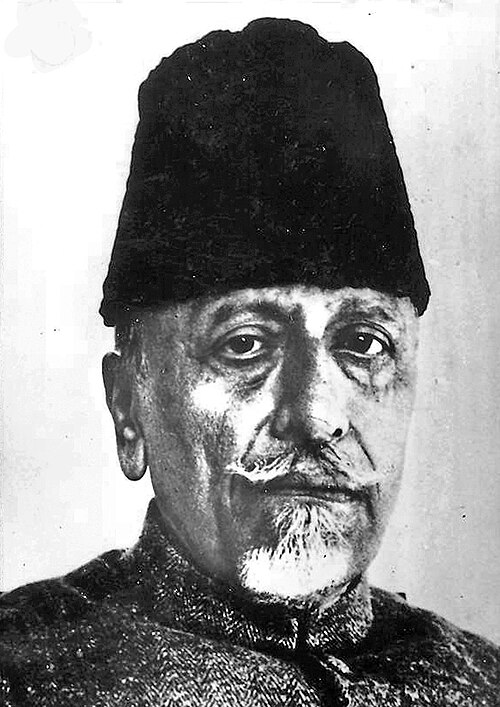
Maulana Abul Kalam Azad
Maulana Abul Kalam Azad (1888–1958) was the conscience of India's freedom movement — a scholar-statesman whose intellectual brilliance and unwavering moral clarity shaped the very soul of Indian nationalism. Born in Mecca to an Indian scholar father and an Arab mother, his family settled in Calcutta where he mastered Arabic, Persian, Urdu, and English. An independent thinker who rejected both colonial servitude and communal separatism, he forged a vision of India where faith and freedom could walk hand in hand.
In 1912, at just twenty-four, Azad launched the Urdu weekly Al-Hilal — and India's political landscape was never the same. The journal's fiercely anti-colonial editorials electrified a generation, prompting the British to ban it in 1914 and intern him in Ranchi for six years. Upon release, he emerged as one of Gandhi's closest collaborators in the Khilafat and Non-Cooperation Movements. In 1923, at age thirty-five, he became the youngest President of the Indian National Congress. Re-elected in 1940, he guided the party through the Quit India Movement and the crucible of partition, spending over three years imprisoned in Ahmednagar Fort — where he wrote some of his most profound reflections on faith, freedom, and nationhood.
As independent India's first Minister of Education (1947–1958), Azad laid the foundations of the nation's intellectual infrastructure — the University Grants Commission, the first IITs, the Sahitya Akademi, and the ICCR. His posthumously published memoir, India Wins Freedom, remains one of the most honest insider accounts of partition ever written. He was a towering figure who proved that Islam and secular democracy were not just compatible — they were inseparable pillars of the Indian republic he helped to build.
Sources & Further Reading
Reference Works & Official Portals
- Encyclopaedia Britannica. "Abul Kalam Azad."
- Indian Culture Portal (Govt. of India). "Maulana Abul Kalam Azad."
Primary Sources & Memoirs
- Maulana Abul Kalam Azad. India Wins Freedom: The Complete Version. Orient Blackswan, 1988.
- Maulana Abul Kalam Azad. Ghubar-e-Khatir (Letters from Ahmednagar Fort prison, 1942–1945). Sahitya Akademi.
Scholarly Biographies & Monographs
- Ian Henderson Douglas. Abul Kalam Azad: An Intellectual and Religious Biography. Oxford University Press, 1988.
- Syeda S. Hameed. Islamic Seal on India's Independence: Abul Kalam Azad. Oxford University Press, 1998.
- Mushirul Hasan. Islam and Indian Nationalism: Reflections on Abul Kalam Azad. Manohar, 1992.