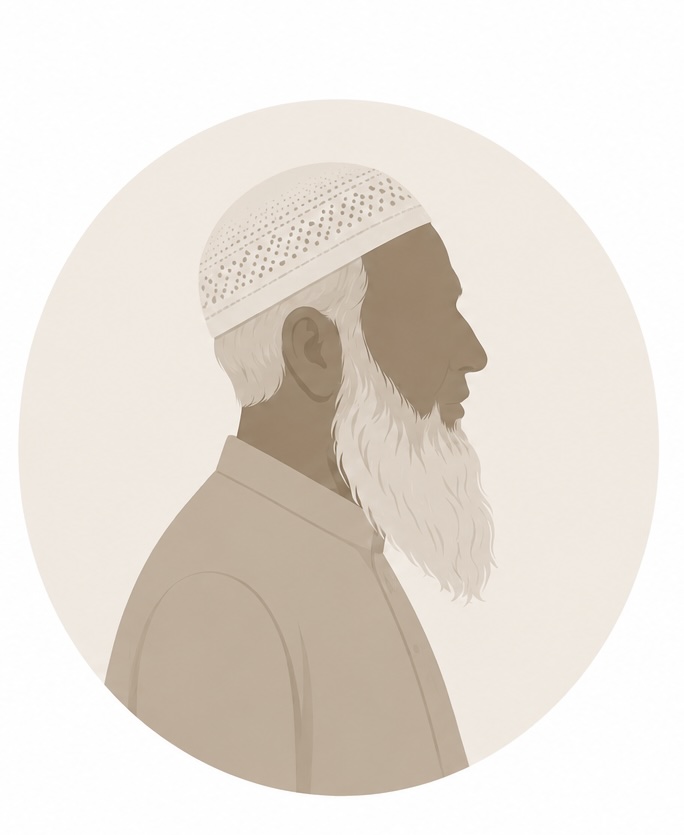
Maulana Abul Muhasin Sajjad
Maulana Abul Muhasin Muhammad Sajjad (1880–1940) was the conscience of Bihar's freedom movement — a scholar-organizer who mobilized the most marginalized communities and refused to let the politics of division tear his province apart. Born in Nawada district, educated at Deoband, he returned to Bihar determined to build institutions that would serve both faith and freedom.
In 1921, Sajjad founded the Imarat-e-Shariah in Bihar and Orissa — an organization that provided community dispute resolution, educational institutions, and social welfare within a framework explicitly supportive of Indian national independence. It was a remarkable synthesis: Islamic jurisprudence deployed not to separate Muslims from the national struggle but to anchor them within it. He led the Khilafat and Non-Cooperation Movements across Bihar, with a particular focus on mobilizing the Momin weavers — one of the most marginalized Muslim communities — into the political mainstream.
In 1936, Sajjad established the Muslim Independent Party to contest the 1937 elections on a platform of agrarian reform and anti-colonial resistance. As General Secretary of the Jamiat Ulema-e-Hind, he remained an unwavering champion of composite nationalism until his sudden death in November 1940. Bihar lost one of its most principled voices, but the institutions he built — and the communities he organized — continued his work.
Sources & Further Reading
Scholarly Books & Regional Studies
- Mohammad Sajjad. Muslim Politics in Bihar: Changing Contours. Routledge, 2014.
- K.K. Datta. History of the Freedom Movement in Bihar (3 Vols.). Government of Bihar, Patna, 1957.
- P.S. Muhar. "The Muslim Independent Party in Bihar (1937)." Indian Journal of Political Science, 1958.
Institutional Archives
- Imarat-e-Shariah Historical Archives. Records and Publications on Maulana Abul Muhasin Sajjad. Phulwari Sharif, Patna.