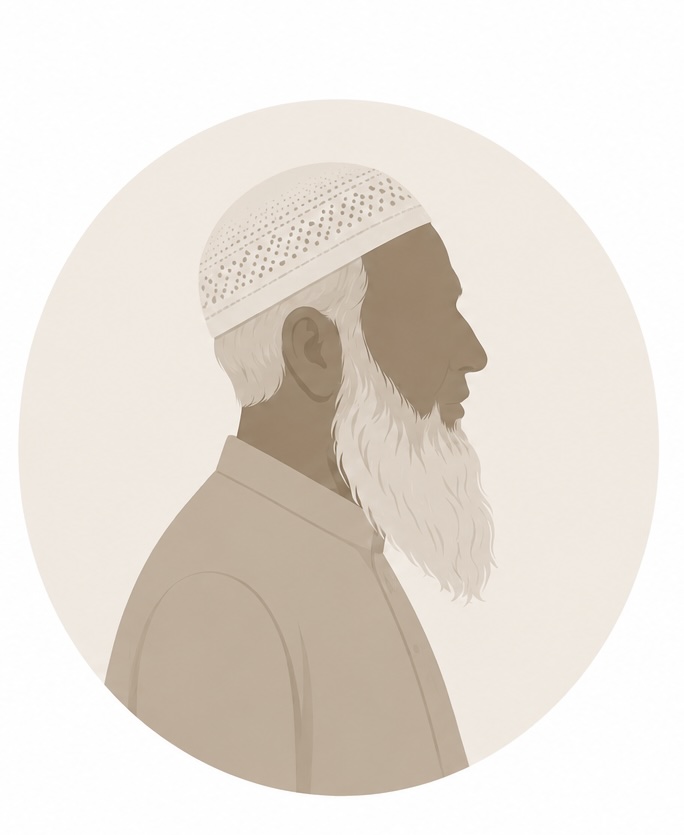
Dr. Khan Sahib
Dr. Khan Sahib (Khan Abdul Jabbar Khan, 1883–1958) was the physician-statesman who, alongside his legendary younger brother Khan Abdul Ghaffar Khan, brought the Frontier into the heart of India's freedom movement. Educated at St Thomas' Hospital in London, he could have built a comfortable medical career anywhere in the empire. Instead, he returned to the North-West Frontier and joined his brother's crusade — trading his stethoscope for the rough-and-tumble of anti-colonial politics.
Elected to the NWFP Legislative Assembly in 1937, Dr. Khan Sahib became the province's first Chief Minister, leading a Congress government that implemented agrarian debt relief, educational reform, and civil liberties in one of the most militarized zones of the British Empire. His premiership was a living rebuke to the Muslim League's claim that Congress could not represent Muslim interests — here was a Muslim doctor, governing a Muslim-majority province, under a Congress flag. He was re-elected in 1945, imprisoned during the Quit India Movement, and emerged more determined than ever.
When partition came, Dr. Khan Sahib chose to remain in Pakistan, attempting to continue his political work in the nation that had been carved from his homeland. He served briefly as Chief Minister of West Pakistan in the 1950s before he was assassinated in Lahore in 1958 — a victim of the very politics of division he had spent his life fighting against. He died as he had lived: a bridge-builder in a world determined to burn bridges.
Sources & Further Reading
Scholarly Books & Legislative Histories
- Mukulika Banerjee. The Pathan Unarmed: Opposition and Memory in the North West Frontier. Oxford University Press, 2000.
- Amit Kumar Gupta. NWFP Legislature and Freedom Struggle 1901–47. Indian Council of Historical Research, 1976.