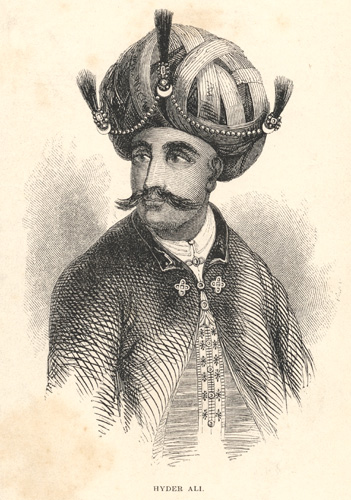
Haider Ali
Haider Ali (c. 1720–1782) was the self-made soldier-king who rose from obscurity to become the first ruler in southern India to humble the British East India Company on the battlefield. Starting as an ordinary soldier in the Mysore army, his raw talent, iron will, and instinct for military strategy propelled him to commander-in-chief and eventually the de facto ruler of one of the most powerful kingdoms in 18th-century India. He rebuilt the Mysore army with French-trained officers, established artillery foundries at Dindigul, and created an intelligence network that kept him one step ahead of his enemies.
In the First Anglo-Mysore War (1767–1769), Haider Ali executed one of the most audacious campaigns in Indian military history — marching his cavalry to the very gates of Fort St. George in Madras and forcing the terrified British administration to sign a humiliating treaty on his terms. He was not merely fighting the British; he was demonstrating, for the first time, that they could be beaten. The lesson was not lost on his son Tipu Sultan, who would carry that fire forward.
Haider Ali was more than a warrior. He reorganized revenue collection, built roads and trade infrastructure, and governed a diverse kingdom where Hindus and Muslims served side by side in the highest offices of state. He died in camp in December 1782, still in the saddle, still at war with the Company. But the kingdom and the defiance he built passed to his son — a father's greatest gift to a son, and a dynasty's greatest gift to India's long resistance against colonial conquest.
Sources & Further Reading
Reference Works & Archives
Scholarly Books & Histories
- N.K. Sinha. Haidar Ali. A. Mukherjee & Co., Calcutta, 1959 (3rd Edition).
- Lewin B. Bowring. Haidar Alí and Tipu Sultán and the Struggle with the Musalman Powers of the South. Clarendon Press, Oxford, 1893.