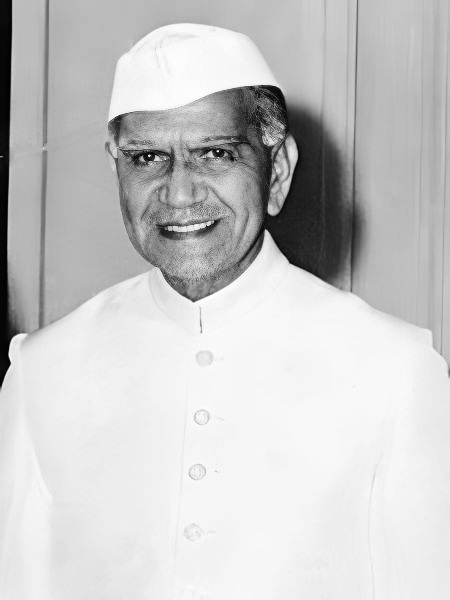
Fakhruddin Ali Ahmed
Fakhruddin Ali Ahmed (1905–1977) rose from the provincial politics of Assam to the highest office in the land, becoming the fifth President of India — a journey that embodied the promise of the republic. Born in Delhi to an Assamese Muslim family, educated at Cambridge and the Inner Temple, he returned to India as a barrister but was soon swept into the current of the freedom movement. He joined the Congress in 1931 and never looked back.
As a minister in Gopinath Bordoloi's cabinet in Assam, Ahmed implemented progressive land reforms and social welfare policies that directly improved the lives of peasants and workers. During the Quit India Movement, he was imprisoned for over three years in Jorhat Jail — enduring harsh conditions without wavering. His courage during those years earned him the lasting respect of his colleagues and the people of Assam.
In independent India, Ahmed served as a Union Cabinet Minister, Advocate General of Assam, and in 1974 was elected President of India — only the second Muslim to hold the office after Dr. Zakir Hussain. He died in office in 1977, his tenure marked by the complexities of a nation still finding its democratic footing. Whatever the controversies of his presidency, his life traced the arc of the freedom movement: from colonial prison to Rashtrapati Bhavan, a testament to the possibilities that independence had opened.
Sources & Further Reading
Reference Works & Official Portals
- Encyclopaedia Britannica. "Fakhruddin Ali Ahmed."
- Wikipedia. "Fakhruddin Ali Ahmed."
- Rashtrapati Bhavan Archives. "Former Presidents: Fakhruddin Ali Ahmed."
Scholarly Biographies & Regional Histories
- M.A. Naidu. Fakhruddin Ali Ahmed. Kamal Publications, New Delhi, 1975.
- Amalendu Guha. Planter-Raj to Swaraj: Freedom Struggle and Electoral Politics in Assam. Indian Council of Historical Research, 1977.