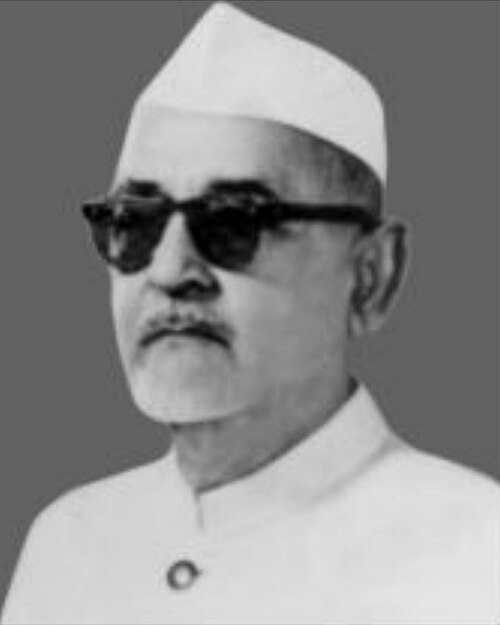
Dr. Zakir Hussain
Dr. Zakir Hussain (1897–1969) was an educationist who rose from the classrooms of Jamia Millia Islamia to become the third President of India — a journey that embodied the republic's deepest promise. Born in Hyderabad, he studied economics in Berlin before returning to India and answering Gandhi's call to build a nationalist education system free from colonial control. In 1920, he became one of the founding members of Jamia Millia Islamia, an institution born from the spirit of non-cooperation that he would nurture for decades as its Vice-Chancellor.
In 1937, Gandhi appointed him to chair the Basic National Education Committee, where he designed the Wardha Scheme — a pioneering vision of education that integrated vocational craft with academic learning, rooted in Indian realities rather than colonial imitation. He guided Jamia through the agony of partition, when the university became a sanctuary for displaced students and faculty. Through every crisis, he remained steadfast in his belief that education was the foundation upon which a free and just society must be built.
In 1967, Dr. Zakir Hussain was elected the third President of India, becoming the first Muslim to occupy Rashtrapati Bhavan — not as a representative of any community, but as the embodiment of the republic's promise that every citizen, through service and scholarship, could reach the highest office in the land. Awarded the Bharat Ratna in 1963, he died in office in 1969, having spent his entire life building the institutions that would educate a free nation.
Sources & Further Reading
Reference Works & Official Portals
- Encyclopaedia Britannica. "Zakir Husain."
- Wikipedia. "Zakir Husain (politician)."
- President of India Official Portal. "Former Presidents: Dr. Zakir Husain."
Scholarly Biographies & Educational Histories
- M. Mujeeb. Dr. Zakir Husain: A Biography. National Book Trust, 1972.
- A.G. Noorani. President Zakir Husain: A Quest for Excellence. Popular Prakashan, 1967.