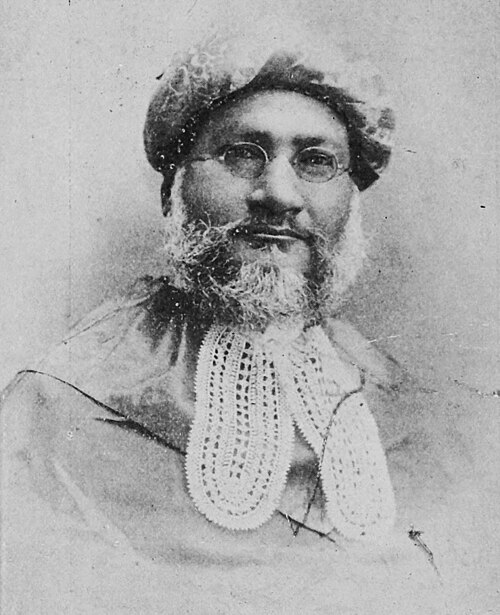
Badruddin Tyabji
Badruddin Tyabji (1844–1906) was a pioneer who broke every barrier the colonial order placed before Indian Muslims. Born into a prominent merchant family in Bombay, he traveled to England and, in 1867, became the first Indian barrister ever called to the Bar at the Middle Temple — a distinction that announced to the empire that Indians would not be confined to second-class status.
Returning to Bombay, Tyabji threw himself into the struggle for civic rights and political representation, co-founding the Bombay Presidency Association in 1885 alongside Pherozeshah Mehta and K.T. Telang. In 1887, he presided over the third session of the Indian National Congress in Madras, becoming its first Muslim President. Standing before a nation still finding its political voice, he declared that the Congress belonged to every Indian, regardless of faith — and urged Muslims to join the national movement in strength. It was a moment of profound political courage at a time when many in his community viewed the Congress with suspicion.
Tyabji's vision extended beyond politics. A fierce advocate for women's education and an opponent of purdah, he sent his own daughters abroad to study — a decision that scandalized conservative opinion but opened doors for generations to come. He co-founded the Anjuman-i-Islam of Bombay in 1874 and, in 1895, became the first Indian Muslim appointed as a permanent Judge of the Bombay High Court. His ascent to the highest bench of the presidency was more than a personal triumph — it was proof that Indians could master the very institutions the empire had built to exclude them.
Sources & Further Reading
Scholarly Biographies & Histories
- A.G. Noorani. Badruddin Tyabji. Publications Division, Ministry of Information and Broadcasting, Govt. of India, 1969.
- Gordon Johnson. Provincial Politics and Indian Nationalism: Bombay and the Indian National Congress 1880–1915. Cambridge University Press, 1973.
Primary Sources
- Indian National Congress. Presidential Address of Badruddin Tyabji, 3rd Session, Madras, December 1887.