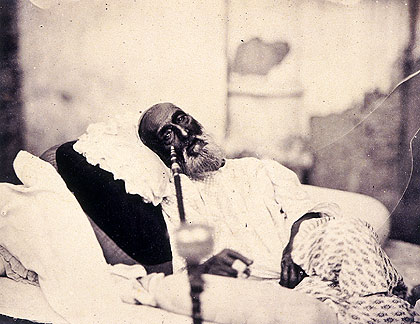
Bahadur Shah Zafar
Bahadur Shah Zafar (1775–1862), the last Mughal Emperor, was a poet and a mystic who never sought the throne of war — but when history demanded it, he became the reluctant symbol around whom the greatest rebellion of the 19th century was fought. Ascending the Mughal throne in 1837, his authority barely extended beyond the Red Fort. He was a pensioner of the East India Company, a patron of poetry and calligraphy, a Sufi who found solace in verse rather than power. But destiny had other plans.
On 11 May 1857, rebel sepoys from Meerut stormed into Delhi and proclaimed Bahadur Shah Zafar the Emperor of Hindustan. The aging poet-king, thrust onto the stage of war, became the face of a rebellion that spread like wildfire across northern India. Under his name, proclamations were issued calling for Hindu-Muslim unity against Company rule. The Red Fort, which had been a gilded cage, became the headquarters of a revolution. For four months, Delhi held — a city under siege, an empire's ghost fighting its last battle.
When British forces recaptured Delhi in September 1857, Zafar was captured at Humayun's Tomb, his sons executed before his eyes. Tried in a humiliating military court within his own palace, he was stripped of his title and exiled to Rangoon, where he spent his final years composing verses of loss and longing. He died on 7 November 1862, the last of a dynasty that had ruled India for three centuries. But his name had already become immortal — inscribed forever on the first great war for India's freedom.
Sources & Further Reading
Reference Works & Archives
- Encyclopaedia Britannica. "Bahadur Shah II."
- Wikipedia. "Bahadur Shah Zafar."
- National Archives of India. Proceedings of the Trial of Bahadur Shah Zafar (1858).
Scholarly Monographs & Histories
- William Dalrymple. The Last Mughal: The Fall of a Dynasty, Delhi 1857. Bloomsbury, 2006.
- Surendra Nath Sen. Eighteen Fifty-Seven. Publications Division, Ministry of Information & Broadcasting, Govt. of India, 1957.