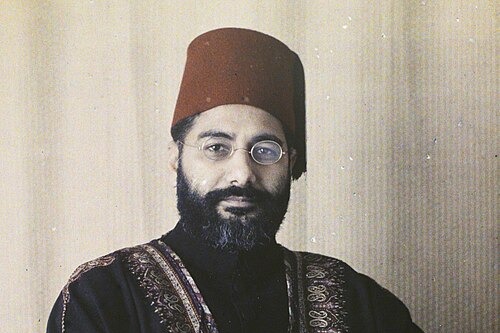
Maulana Syed Sulaiman Nadwi
Maulana Syed Sulaiman Nadwi (1884–1953) was the historian who completed one of the greatest biographical works in Islamic literature — Sirat-un-Nabi, the multi-volume life of the Prophet Muhammad — and then turned his scholarly gaze on the living history unfolding around him. Born in Bihar, he was the star pupil of Allama Shibli Nomani at the Nadwatul Ulama in Lucknow, inheriting his mentor's commitment to rigorous historical method and elegant Urdu prose.
In 1914, Nadwi co-founded the Darul Musannefin Shibli Academy in Azamgarh, transforming it into a premier center for historical research and publication in Urdu. He was an active supporter of the Khilafat Movement, channeling his scholarship into the service of anti-colonial politics. His works on Islamic history, the Quran, and comparative religion were read across the Muslim world, and his academic reputation earned him a professorship at Deccan College in Pune.
In the 1940s, Nadwi made the painful decision to support the Muslim League and the demand for Pakistan — a shift that disappointed many of his Congress allies but reflected his genuine conviction that Muslim interests required separate statehood. He migrated to Pakistan in 1950 and served as Chairman of the Board of Talimat-e-Islamia, advising on the constitutional role of Islam in the new state. He died in Karachi in 1953, leaving a scholarly legacy that transcends the borders his politics helped create.
Sources & Further Reading
Reference Works
Scholarly Books & Institutional Histories
- Shibli Nomani & Sulaiman Nadwi. Sirat-un-Nabi (Vols. I–VI). Darul Musannefin Shibli Academy, Azamgarh.
- Jamal Malik. Islam in South Asia: A Short History. E.J. Brill, 2008.