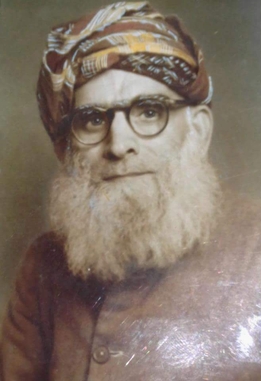
Maulana Habibur Rehman Ludhianvi
Maulana Habibur Rehman Ludhianvi (1892–1956) was the Deobandi scholar who stood in the path of partition and refused to move. Born in Ludhiana, Punjab, he studied at Darul Uloom Deoband under Maulana Mahmud Hasan and emerged from the seminary with a conviction that would define his life: that Muslims and Hindus were one nation, bound by the same soil and the same struggle. In 1929, he co-founded the Majlis-e-Ahrar-e-Islam in Lahore — a movement that mobilized working-class Muslims, artisans, and peasants against both British colonialism and the feudal structures that kept them poor.
Ludhianvi was the organizational engine of the Ahrar movement across Punjab. He organized civil disobedience campaigns, coordinated agricultural workers and handloom weavers, and spent years in British prisons — each sentence a badge of honor. He was a relentless campaigner, crisscrossing the province that would be most devastated by partition, pleading with Muslims to reject the politics of division and embrace a shared future. His speeches were not abstract theology; they were desperate, passionate appeals to save a nation from tearing itself apart.
When partition came despite every effort, Ludhianvi chose to remain in India. He continued his community work, his teaching, and his unwavering advocacy for the rights of Muslims in the secular republic. He died in 1956, having spent his life arguing — from the Quran, from the Sunnah, from the depths of his conscience — that Muslims and Hindus belonged together.
Sources & Further Reading
Reference Works
Scholarly Books & Monographs
- Samina Awan. Political Islam in Colonial Punjab: Majlis-i-Ahrar 1929–1949. Oxford University Press, 2010.
- Wilfred Cantwell Smith. Modern Islam in India: A Social Analysis. Victor Gollancz, London, 1946.