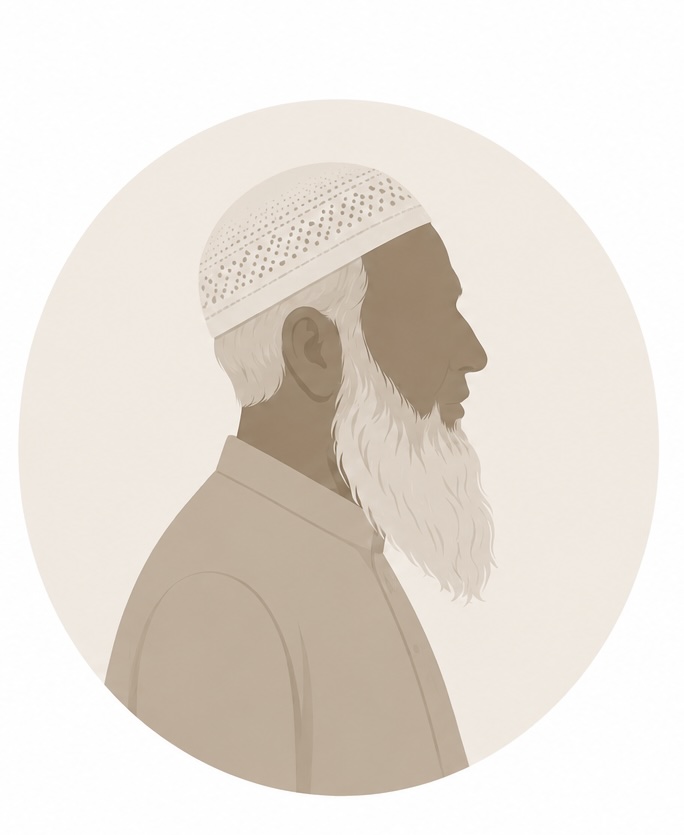
Maulana Habibur Rahman Sani
Maulana Habibur Rahman Sani (1893–1973) was the Deobandi stalwart who spent six decades in the service of his faith and his nation — a scholar who understood that the mosque and the polling booth were not enemies but allies in the struggle for justice. Born in Deoband itself, the town whose name became synonymous with Islamic revival and anti-colonial resistance, he studied under the great masters of the seminary and inherited their conviction that religious learning must serve the cause of freedom.
During the Khilafat and Non-Cooperation Movements, Sani organized scholars and rural communities across western Uttar Pradesh to boycott British courts, schools, and administrative institutions. Imprisoned multiple times, he emerged from each incarceration more determined. In the 1940s, he stood resolutely against partition, rejecting the Muslim League's Two-Nation Theory and campaigning for composite nationalism when the tide of history was flowing in the opposite direction.
After 1947, Sani served in the Uttar Pradesh Legislative Assembly and remained a senior leader of the Jamiat Ulema-e-Hind, working to protect minority rights, expand educational opportunities, and reassure Indian Muslims of their full place in the secular republic. He lived to see 1973 — nearly a century that spanned colonialism, freedom, partition, and the building of a new nation. Through it all, he remained what he had always been: a scholar, a patriot, and a bridge.
Sources & Further Reading
Scholarly Books & Institutional Histories
- Barbara D. Metcalf. Islamic Revival in British India: Deoband, 1860–1900. Princeton University Press, 1982.
- Muhammad Miyan Deobandi. Ulama-e-Hind ka Shandar Mazi (The Glorious Past of the Indian Ulama). Jamiat Ulema-e-Hind.