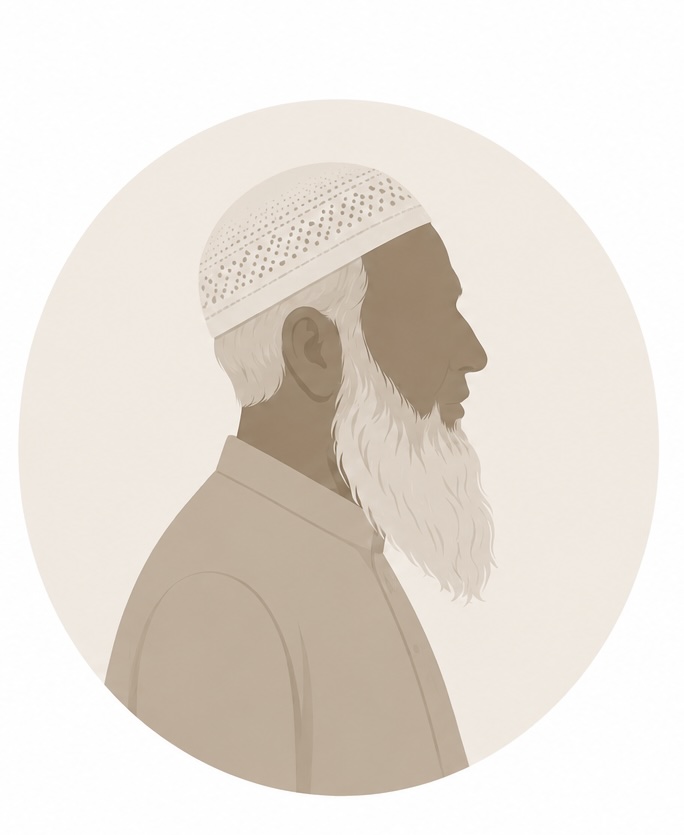
Maulana Abdul Awwal Jaunpuri
Maulana Abdul Awwal Jaunpuri (1867–1921) was the scholar who carried his father's reformist torch across the rivers and rice fields of Bengal — a prolific author, a tireless educator, and a freedom fighter who understood that the most powerful weapon against colonialism was literacy. The son of Karamat Ali Jaunpuri, he inherited the leadership of the Taiyuni reform movement and expanded it into a vast educational and anti-colonial awakening across eastern India.
Jaunpuri was a writer of staggering productivity — over a hundred scholarly books in Urdu, Arabic, and Persian that addressed educational reform, social equity, and religious renewal. But he was no ivory-tower academic. He traveled relentlessly through the villages of Bengal, Bihar, and Assam, establishing schools in places that had never seen one, teaching rural populations to read, and insisting that knowledge was the birthright of every Muslim — man or woman, rich or poor. His classrooms were sometimes under trees; his students were sometimes illiterate peasants. He taught them all.
When the Khilafat and Non-Cooperation Movements swept India in the early 1920s, Jaunpuri threw his moral authority behind the cause, standing before crowds in Kolkata and Dhaka and urging Muslims to join the national struggle. He died in Kolkata in 1921, but the schools he built and the students he taught continued his work for generations — proof that a teacher's legacy is measured not in monuments but in minds awakened.
Sources & Further Reading
Reference Works
Scholarly Books
- Muhammad Mojlum Khan. The Muslim Heritage of Bengal. Kube Publishing, 2013.
- Rafiuddin Ahmed. The Bengal Muslims, 1871–1906: A Quest for Identity. Oxford University Press, 1981.