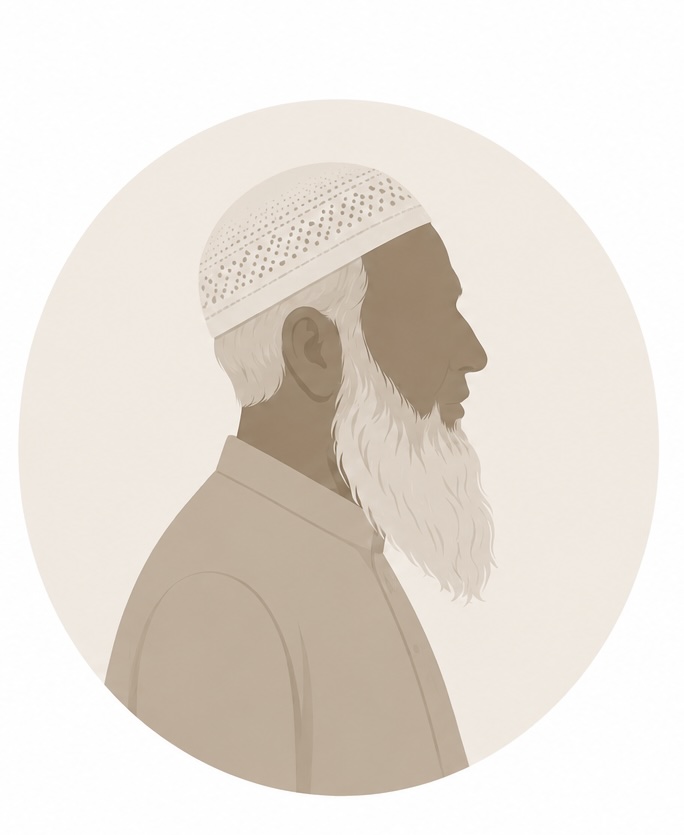
Haji Imdadullah Muhajir Makki
Haji Imdadullah Muhajir Makki (1817–1899) was the spiritual colossus behind the Deoband movement — a Sufi master of the Chishti and Naqshbandi orders whose disciples founded Darul Uloom Deoband and shaped the course of Islamic learning and anti-colonial resistance in South Asia for over a century. Born in Nanauta, Saharanpur district, he was orphaned young and, against all odds, taught himself the Quran before traveling to Delhi to study under Mamluk Ali Nanautavi.
During the 1857 Rebellion, Imdadullah did what many scholars only preached: he led an armed uprising as the commander (amir) of the resistance in Thana Bhawan, mobilizing local forces against the East India Company. His forces fought the British at the Battle of Shamli in May 1857, alongside his disciples Muhammad Qasim Nanautavi and Rashid Ahmad Gangohi — both of whom fought under his command. When the uprising was crushed and warrants were issued for his arrest, he chose exile over execution, migrating to Mecca in 1857. He would spend the remaining four decades of his life there, earning the epithet "Muhajir Makki" — the Migrant of Mecca.
Imdadullah's most enduring legacy was not in battle but in the scholars he trained. His spiritual disciples — Muhammad Qasim Nanautavi, Rashid Ahmad Gangohi, Khalil Ahmad Saharanpuri, Ashraf Ali Thanwi, and Mahmud Hasan Deobandi — founded the major seminaries of South Asia including Darul Uloom Deoband, Mazahir Uloom, and Nadwatul Ulama, all under his guidance from exile. From Mecca, he corresponded ceaselessly with his followers, providing spiritual direction and urging them to build independent, publicly-funded institutions free from colonial patronage. He died in Mecca in 1899 and was buried in the Jannat al-Mu'alla cemetery, beside his fellow exile and friend Rahmatullah Kairanwi. The movement he inspired would go on to produce the Silk Letter conspiracy, the Jamiat Ulema-e-Hind, and generations of scholar-activists who resisted British rule in India.
Sources & Further Reading
Reference Works & Encyclopedias
Scholarly Books & Monographs
- Moin Ahmad Nizami. Haji Imdadullah. Oxford University Press, 2024.
- Scott Kugle. Sufis & Saints' Bodies: Mysticism, Corporeality, and Sacred Power in Islam. University of North Carolina Press, 2007.
- Barbara D. Metcalf. Islamic Revival in British India: Deoband, 1860–1900. Princeton University Press, 1982.
- T. H. Rizvi. "Haji Imdadullah of Thana Bhawan: A Brief Survey of His Life and Work (1818–1899)." Proceedings of the Indian History Congress, Vol. 47, 1986.