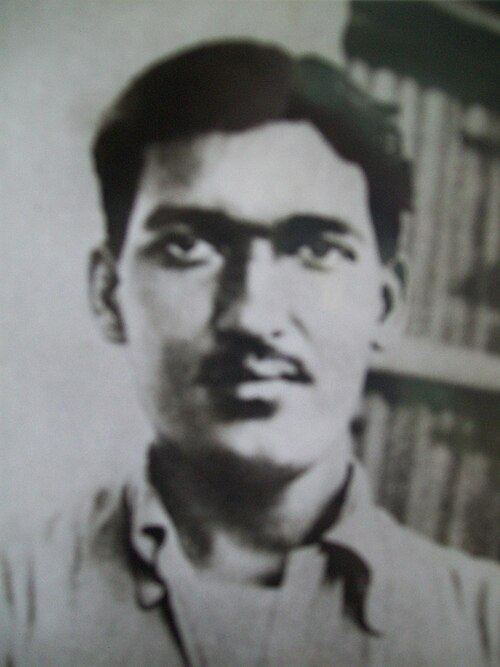
Ashfaqulla Khan
Ashfaqulla Khan (1900–1927) was the revolutionary who proved that love of one's motherland transcends every boundary of faith. A young Muslim from Shahjahanpur in Uttar Pradesh, he grew up in the turbulent aftermath of the Rowlatt Act and Jallianwala Bagh, where the brutality of colonial rule radicalized an entire generation. Drawn to the Hindustan Republican Association, he found not only a cause but a brotherhood — fighting alongside Ram Prasad Bismil, Chandrashekhar Azad, and others who believed that freedom was worth any price.
On 9 August 1925, Ashfaqulla took part in the daring Kakori Train Action, a meticulously planned raid to seize government treasury funds for the revolutionary movement. Not a single rupee was taken for personal enrichment — every coin was destined for the cause of liberation. When British intelligence launched a massive manhunt, he evaded capture for over a year, moving through Delhi and Bihar under aliases, sheltered by ordinary Indians who risked their own lives to protect him. He was finally betrayed and arrested in late 1926.
Tried in the infamous Kakori Conspiracy Case, Ashfaqulla Khan was sentenced to death. In his prison cell, he wrote poetry under the pen name "Hasrat" — verses that burned with devotion to the motherland and acceptance of his fate. On 19 December 1927, he was hanged at Faizabad District Jail, reciting verses of the Quran with his final breath. He was twenty-seven. His deep friendship with Ram Prasad Bismil and his sacrifice alongside Hindu comrades remain an eternal testament to what India could have been — and what its freedom fighters, at their best, truly were.
Sources & Further Reading
Reference Works & Official Portals
- Indian Culture Portal (Govt. of India). Freedom Fighters: Ashfaqulla Khan.
- Wikipedia. "Ashfaqulla Khan."
Primary Documents & Memoirs
- Ram Prasad Bismil. Kakori Ke Shaheed (Autobiographical reflections on Ashfaqulla Khan and the Kakori trials). 1927.
Scholarly Books & Trial Records
- Kama Maclean. A Revolutionary History of Interwar India: Violence, Image, Voice and Text. Oxford University Press, 2015.
- Malwinder Jit Singh Waraich & K.C. Yadav. Kakori Martyrs: Action & Final Trial. Unistar Books, 2007.