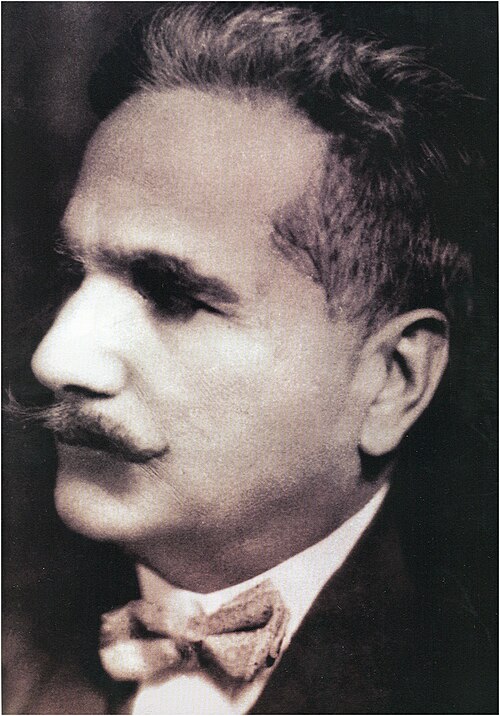
Allama Muhammad Iqbal
Allama Muhammad Iqbal (1877–1938) was the poet-philosopher who dreamed a nation into existence — and whose verses still echo in the hearts of millions across borders and generations. Educated at Cambridge and Munich, where he earned a doctorate in philosophy, he returned to Lahore and began writing poetry in Urdu and Persian that would reshape the consciousness of South Asian Muslims. His concept of khudi — the awakening of the self — was not merely a philosophical idea but a battle cry against the passivity and despair that colonialism had inflicted upon his people.
In 1904, Iqbal wrote "Tarana-e-Hindi" — "Saare Jahan Se Achcha Hindustan Hamara" — a patriotic anthem that transcended religion and became one of the most beloved songs of the Indian subcontinent. His masterworks, including Asrar-e-Khudi, Bang-e-Dara, and Bal-e-Jibril, combined Sufi mysticism with Nietzschean vitality, calling upon Muslims to reclaim their agency and dignity. He did not merely compose poetry; he composed a new vision of what his people could become.
In his 1930 Presidential Address to the Muslim League in Allahabad, Iqbal articulated the idea of an autonomous Muslim state in northwestern India — the intellectual seed of what would become Pakistan. Yet the man who is remembered as the ideological father of one nation was also one of the greatest poetic voices of another. His verses belong to humanity, and "Saare Jahan Se Achcha" remains a song that every Indian, regardless of faith, can call their own.
Sources & Further Reading
Primary Philosophical Works & Lectures
- Muhammad Iqbal. The Reconstruction of Religious Thought in Islam. Oxford University Press, 1934.
Scholarly Biographies & Studies
- Annemarie Schimmel. Gabriel's Wing: A Study into the Religious Ideas of Sir Muhammad Iqbal. E.J. Brill, 1963.
- Iqbal Singh Sevea. The Political Philosophy of Muhammad Iqbal: Islam and Nationalism in Late Colonial India. Cambridge University Press, 2012.