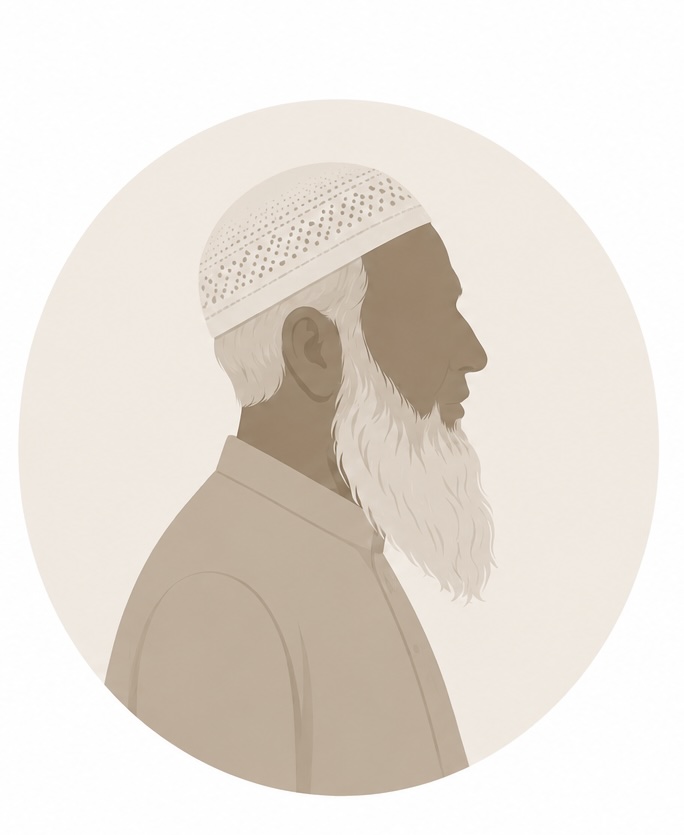
Maulana Hifzur Rahman Seoharwi
Maulana Hifzur Rahman Seoharwi (1900–1962) was the scholar-parliamentarian who carried the Deoband tradition from the madrasa into the Lok Sabha — proving that Islamic learning and democratic governance were not enemies but allies. Born in Seohara, Uttar Pradesh, educated at Darul Uloom Deoband, he became General Secretary of the Jamiat Ulema-e-Hind and one of the most articulate advocates for composite nationalism in the crucial decades before and after partition.
Seoharwi was a prolific author whose works — including Qasas al-Qur'an and Islam ka Iqtisadi Nizam — demonstrated that Islamic scholarship could engage with history, economics, and modern governance. He spent over eight years in British prisons for his anti-colonial activities, each incarceration deepening his conviction that Muslims and Hindus were one nation. During the 1940s, he campaigned relentlessly against partition, arguing from Islamic principles that the division of India would be catastrophic for Muslims.
After independence, Seoharwi was elected to the Lok Sabha from Amroha, serving from 1952 until his death in 1962. As General Secretary of the Jamiat Ulema-e-Hind, he championed the rehabilitation of partition refugees, the protection of minority rights, and the defense of secular democracy. He was living proof that a Deobandi scholar could be a committed parliamentarian — that faith and democracy could speak the same language.
Sources & Further Reading
Reference Works & Portals
- Wikipedia. "Hifzur Rahman Seoharwi."
- Parliament of India (Lok Sabha). "First & Second Lok Sabha Members Bioprofile: Hifzur Rahman Seoharwi."
Primary Works & Scholarly Monographs
- Hifzur Rahman Seoharwi. Qasas al-Qur'an (4 Vols.). Nadwatul Musannefin, Delhi.
- Barbara D. Metcalf. Husain Ahmad Madani: The Jihad for a Secular India. Oneworld Publications, 2008.