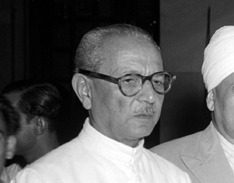
Asaf Ali
Asaf Ali (1888–1953) was the barrister who defended revolutionaries in court and defied the empire from underground — a man who wielded the law as both shield and sword. Educated at St. Stephen's College in Delhi and Lincoln's Inn in London, he returned to India and built a brilliant legal career. But the law as the British practiced it was not justice, and Asaf Ali soon found himself representing those whom the colonial state most wanted to destroy.
In 1929, he defended Bhagat Singh and Batukeshwar Dutt in the Central Assembly Bomb Case — standing beside revolutionaries whom the empire had already condemned in the court of public opinion. In 1945–46, he chaired the INA Defence Committee, organizing the legal team that defended the officers of Subhas Chandra Bose's Indian National Army during the historic Red Fort trials — proceedings that electrified nationalist sentiment across India. During the Quit India Movement of 1942, he went underground, operating the clandestine Congress Radio that broadcast messages of resistance to a nation under lockdown.
After independence, Asaf Ali became India's first Ambassador to the United States and later served as Governor of Odisha. His wife, Aruna Asaf Ali, was the celebrated freedom fighter who had hoisted the Congress flag at Gowalia Tank in 1942 — one of the most iconic acts of the Quit India Movement. Together, they were among the most remarkable couples of the freedom struggle: two lives devoted entirely to a single, consuming cause — liberty.
Sources & Further Reading
Reference Works & Portals
Scholarly Biographies & Legal Histories
- M. Asaf Ali (ed. G.N.S. Raghavan). Asaf Ali: Memoirs and Notes. National Book Trust, 1994.
- A.G. Noorani. The Trial of Bhagat Singh: Politics of Justice. Oxford University Press, 2001.